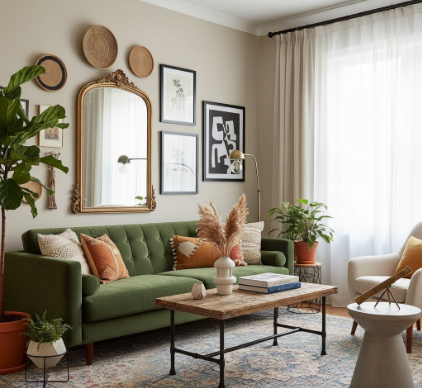
Stepping into the world of interior design can often feel like being asked to choose a single path at a crossroads. You’re told to pick a lane: are you a minimalist, a bohemian, a traditionalist, or a devotee of mid-century modern? But for many of us, our personalities are far too complex to be confined to one label. We might love the clean, uncluttered serenity of Scandinavian design but also crave the rich texture and storytelling of rustic pieces. The fear of creating a chaotic, disjointed mess often paralyzes us, pushing us back toward the safety of a single, uniform look. But here’s the secret: the most captivating, soulful, and deeply personal spaces are almost always a thoughtful blend of multiple styles. Your home should be a reflection of your unique journey, not a page torn from a single catalog.
Successfully combining decor styles is less a science with rigid rules and more an art form built on intuition and a few guiding principles. It’s about creating a conversation between different pieces, where each one has a voice but contributes to a harmonious dialogue. Instead of clashing, the right elements can complement and elevate each other, resulting in a space that feels curated over time, layered with meaning, and authentically yours.
The 80/20 Principle: Establishing a Clear Foundation
The easiest entry point into the world of mixed-style decor is the
80/20 rule. This principle provides a clear and manageable framework that prevents visual chaos. The idea is simple: choose one style to be the dominant theme, making up roughly 80% of your room. This will be your foundation—the main character of your story. It will dictate your largest furniture pieces, your primary color palette, and the overall mood of the space. The remaining 20% is where you get to play. This is your accent style, used for smaller items, accessories, textiles, and art. It adds a dash of surprise, a layer of intrigue, and a hint of a different narrative.
Imagine a living room that is 80% mid-century modern. You have a sofa with clean lines, tapered wooden legs, a simple teak sideboard, and a neutral wall color. It’s calm, functional, and orderly. Now, for your 20%, you introduce elements of a glam or Art Deco style. This could manifest as a plush velvet accent chair in a jewel tone, a brass-and-glass bar cart in the corner, a striking geometric-patterned rug, and a mirror with an ornate, gilded frame. The foundational mid-century modern keeps the room grounded and cohesive, while the glam accents inject personality, luxury, and a touch of the unexpected. The tension between the two styles is what makes the room dynamic and interesting.
Finding the Unifying Thread
Once you’ve decided on your style partners, the most crucial step is to find a common thread that weaves them together. This unifying element is the bridge that connects disparate pieces, making them feel like they belong in the same room. Without it, you have a collection of beautiful but unrelated objects. With it, you have a cohesive design.
The Power of a Consistent Color Palette
Color is arguably the most powerful tool for unifying different styles. By sticking to a limited and consistent color palette, you can make a rustic farmhouse table feel right at home next to a sleek, modern acrylic chair. The shared color tricks the eye into seeing harmony. Choose three to five colors and repeat them throughout the space in varying proportions. For example, a room might be built on a palette of deep navy, crisp white, and warm camel. The navy could appear on an accent wall and a traditional-style sofa. The white might be found on minimalist bookshelves and the trim. The camel could be present in a leather industrial-style armchair, bohemian throw pillows, and the tone of a wooden floor. The styles are different, but the shared color story makes them sing in tune.
The true magic of mixing styles lies not in the individual pieces, but in the connections you create between them. A unifying element, whether it’s a repeated color, a consistent material, or a similar silhouette, is what transforms a simple collection of furniture into a thoughtfully curated interior. This common ground is the secret language that allows different design aesthetics to communicate harmoniously.
A Dialogue of Materials and Textures
Another effective strategy is to repeat materials or textures. If you have a rustic reclaimed wood coffee table, you can connect it to a set of contemporary chairs by ensuring they also have wooden legs, even if the style is completely different. The shared materiality creates a subconscious link. The same goes for metals. You can successfully mix a sleek industrial floor lamp with a delicate, traditional side table if they both share a brushed brass finish. This doesn’t mean everything has to match perfectly. In fact, a bit of variation in finish—like mixing polished brass with aged brass—adds depth. The key is to create a family of materials that are present throughout the room, tying everything together.
Let Shapes and Lines Talk to Each Other
Pay attention to the dominant lines and shapes of your furniture. Some styles are defined by straight, clean, geometric lines (think Minimalism, Art Deco), while others are characterized by soft curves and organic forms (think French Country, Victorian). You can create harmony by either echoing these lines or creating a deliberate, balanced contrast. For instance, the gentle curve of a traditional camelback sofa can be beautifully mirrored in the arc of a modern floor lamp above it. Alternatively, you can use a round, organically shaped coffee table to soften the hard, straight lines of a contemporary sectional sofa. This creates a pleasing visual balance and ensures the pieces are in a dynamic conversation rather than a static arrangement.
Edit, Edit, Edit: The Importance of Breathing Room
One of the biggest mistakes when mixing styles is adding too much. When you have multiple aesthetics at play, negative space—the empty areas around your furniture and objects—becomes more important than ever. Overcrowding the room will instantly make it feel chaotic and cluttered, regardless of how well your pieces are theoretically matched. Each item needs space to be seen and appreciated. It’s better to have fewer, more impactful pieces than a room full of things vying for attention. Be a ruthless editor. If a piece doesn’t contribute to the overall harmony or tell a part of your story, it might be time to let it go. This curation process is what separates a thoughtfully designed, eclectic space from what looks like a disorganized furniture store.